SELECTS: Tarzan the Kid Tells Four Siblings' Stories Through Fashion
The Marrakech-based stylist and designer challenges fashion conventions through four avant-garde looks, each telling the story of a sibling navigating family dynamics, identity, and addiction.

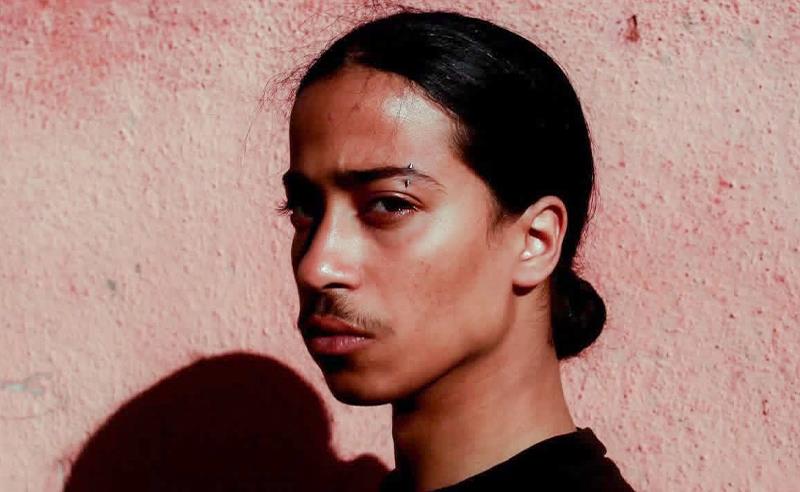
Tarzan the Kid has little interest in keeping up with fashion. “I don’t really follow fashion,” the 20-year-old Marrakech-based designer and stylist explains. Other designers, established labels, and popular culture hold limited appeal as sources of inspiration. Instead, he looks to human emotion, lived experience, and “all the weird stuff we go through as human beings.”
His own relationship with clothing began, somewhat paradoxically, with a desire to disappear. Growing up, Tarzan often felt out of place within his family and community. Dressing became a means of camouflage, a way to conceal himself rather than invite attention. It is a curious starting point for someone whose creations now make such conspicuous demands on the eye.
Despite having taken up styling only two years ago, Tarzan has already attracted attention within Morocco’s music scene. A self-described “skater kid,” he remembers struggling to find the oversized jeans and T-shirts favoured by young skateboarders in Marrakech. The brands he admired were difficult to come by, so he began making the clothes himself.
“I soon realised I could just make them on my own,” he recalls. What began as a practical solution gradually became a small design business, attracting a following among Marrakech’s young creatives and, eventually, local rappers and musicians. Among them is Moroccan rapper Issam, whom Tarzan styled for his comeback music video, ‘Stardancer’, released on October 11th.
Recognition, however, has not made him particularly accommodating. Tarzan is selective about whom he dresses and to whom he sells his creations. “I’m very picky,” he says. “I don’t care about the money, and I have to decide who is going to respect the garment.”
His definition of respect is refreshingly uncomplicated: don't make the clothes ugly. “You can’t buy it and just wear it with a white T-shirt.”
His work belongs to a community of young, alternative dressers in Marrakech for whom clothing offers a means of questioning the conventions around them. Tarzan hopes to reach others who feel similarly out of place, particularly those interested in challenging assumptions about gender, age, and religion through the way they dress.
For this project, he has imagined a family of four siblings, each with a distinct relationship to clothing and to the circumstances of their upbringing. Hand-stitched black leather trousers, obscured faces, and vintage garments sourced from French theatres become instruments of storytelling, revealing the effects of poverty, addiction, jealousy, and familial attachment.
The garments resist fixed identities. A skirt need not belong to a woman, nor a dress to any particular body. Each look is less a prescribed outfit than a portrait of someone attempting to make sense of their place in the world.
Tarzan recognises something of himself in all four siblings: their insecurities, their mistakes, and their attempts at self-definition. He invites the viewer to find something familiar in them, too.
Look 1: The Oldest Brother
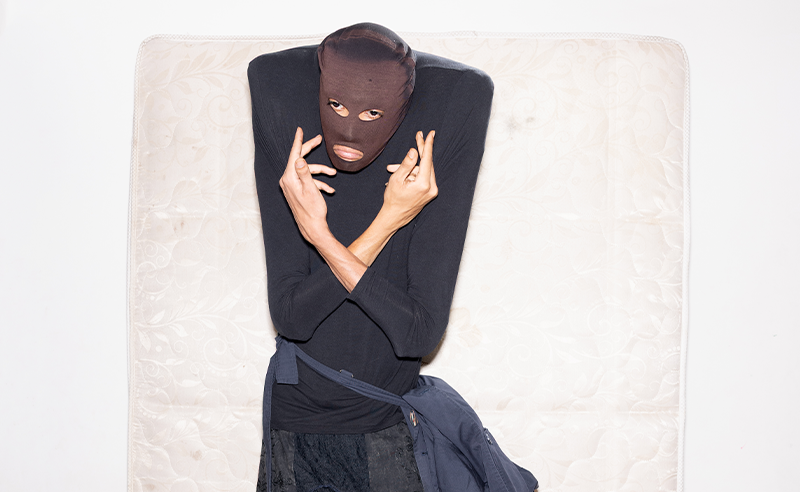 The eldest child has inherited more than his share of the family's difficulties. Born when his parents were less financially secure, the Oldest Brother has experienced a harsher upbringing than his younger siblings, a disparity Tarzan expresses through distressed garments and a long black skirt.
“He isn’t as privileged as his younger siblings,” Tarzan explains. The face covering, meanwhile, suggests a desire to withdraw from the world. “It is a way to hide, trying to be in his own bubble.”
Neglect has driven the character towards drugs and alcohol, and his deteriorating mental health has left him increasingly isolated. Yet his sense of responsibility persists. “He is just trying to care for his siblings, trying to figure things out on his own,” Tarzan says.
As the eldest child in his own family, Tarzan recognises something particularly familiar in this character. He sourced the black top from a Marrakech souk, adding foam shoulder pads to create what he describes as a “look of strength.”
The exaggerated shoulders give the figure an imposing silhouette, though their significance is less straightforward. The Oldest Brother may possess the experience and authority of the firstborn, but he also carries the weight of a family whose difficulties have fallen disproportionately upon him.
Look 2: The Older Sister
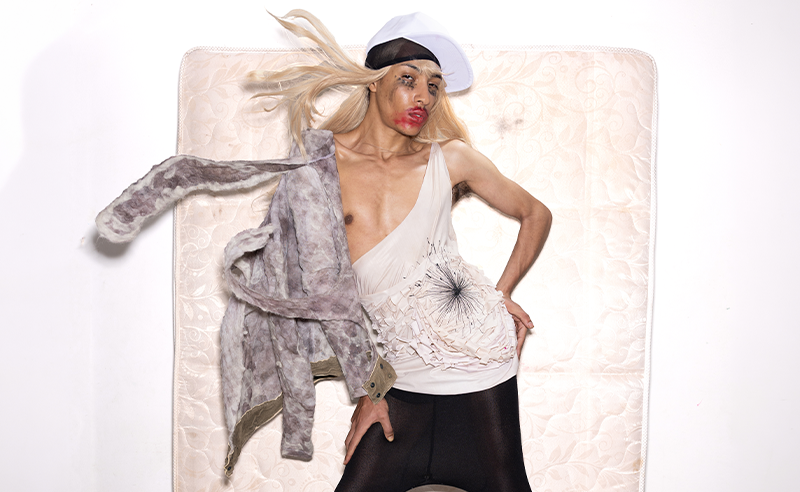 The Older Sister shares her brother's loneliness, though she has developed a rather different method of managing it. Where he retreats into himself, she seeks refuge in nightlife, surrounding herself with friends and parties that offer temporary relief from the difficulties at home.
Her appearance suggests a night that has gone on considerably longer than intended. Makeup is smudged, her dress appears to be slipping from her shoulders, and her clothes have acquired a certain studied disarray. There is nevertheless something poised about her, even in apparent dishevelment.
Tarzan sourced the white dress and fur coat from a theatre in France, then bleached, stained, and tore the garments to give them a more distressed texture.
“She is a sweet girl,” he says, though her family's circumstances have pushed her towards late nights and the fleeting comforts of a social life conducted largely outside the home.
Could things have turned out differently? It is a question Tarzan asks of all four siblings. Each possesses the possibility of another life, yet the circumstances of their upbringing continue to shape the decisions they make, often to their own detriment.
Look 3: The Middle Brother
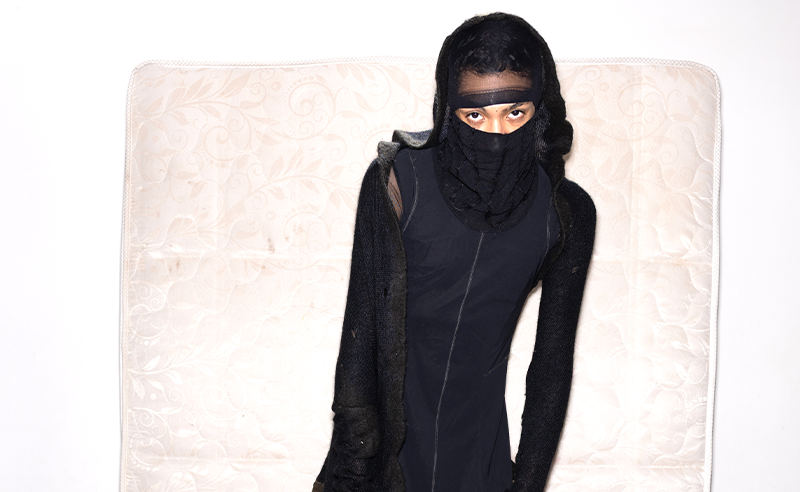 The Middle Brother is perhaps the family's most overlooked member. Masked and dressed entirely in black, he appears almost to disappear into his clothing, his narrow silhouette suggesting the physical consequences of neglect.
A close-fitting black dress accentuates his thinness, while the obscured face reinforces his isolation. Having grown up in the shadow of his older siblings and the family's persistent difficulties, he has learned to occupy as little space as possible.
Yet his wardrobe is also the most experimental of the four. He wears heels, a fitted dress, and gathered waxed jeans, combining thrifted garments with pieces from Tarzan's own collection. The result is a figure whose apparent withdrawal conceals a developing curiosity about self-expression.
Tarzan describes him as a “loner,” someone who has yet to establish much of a social life or a clear sense of his own identity. His older siblings remain powerful influences, though he is beginning to question whether their choices should determine his own.
Of the four, he seems suspended most visibly between imitation and independence, still deciding what kind of person he might become.
Look 4: The Youngest Sister
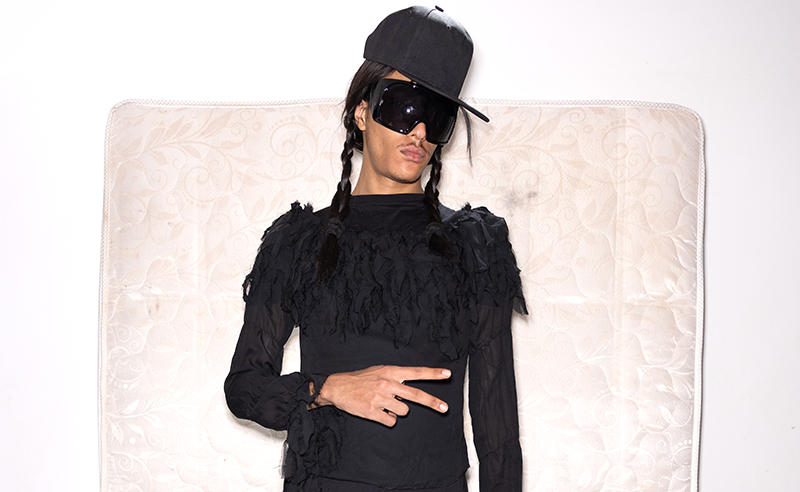 By the time the Youngest Sister arrives, the family's circumstances have improved. There is more money, less parental severity, and, crucially, the accumulated experience of three older siblings whose mistakes she has had the opportunity to observe.
“She is more confident, cool, and comfortable,” Tarzan explains. Unlike her siblings, she has grown up with a degree of security that allows her to approach the world without the same instinct to conceal herself.
Her wardrobe reflects this relative ease. Tailored silhouettes replace the distressed, dishevelled garments of her older siblings, giving her appearance a more composed and deliberate quality. Tarzan designed her top and leather jeans using locally sourced materials, creating a look that feels assured without abandoning the family's shared visual language.
The black leather trousers recall the Middle Brother's outfit, while her hat echoes the Older Sister's. These references suggest that, however different her upbringing may have been, her identity remains inseparable from those who came before her.
Her parents, too, have changed. Having raised three children already, they are less strict and more understanding, allowing their youngest greater freedom to experiment with who she wants to be.
“She feels good in her own skin,” Tarzan says. “She’s not afraid of who she is or how she wants to represent herself.”
It is a freedom her older siblings have spent much of their lives trying to acquire. For the Youngest Sister, it is simply where her story begins.
- Previous Article Karen Wazen on Insecurities, Eyewear and Her Egyptian Homecoming