Ancient Egypt Is the Blueprint for Nakhla - Now It’s Selling at GEM
“Egypt is the inspiration of the world”: How one Egyptian family of designers draws on the past to create contemporary classics.
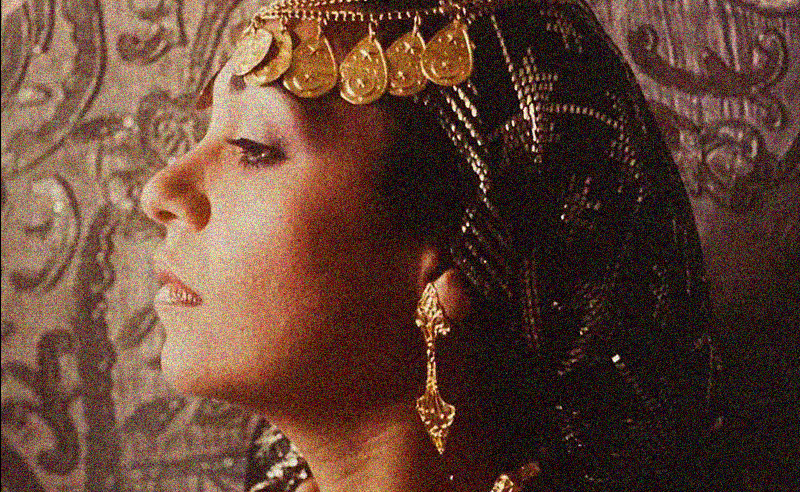
As you walk into the Grand Egyptian Museum, you are greeted by the colossal statue of Ramses II. Standing as he always has - tall, proud, commanding - he carries with him the majesty of Egypt’s ancient history. Look just beyond him, you will see replicas of Nefertiti’s bust adorned with gold jewellery and precious stones. Sitting beside them, just as graceful and no less elegant, is Laila Neamatalla: co-founder of Nakhla Jewellery.
However, this is not a story that begins in this museum. It begins near the Nile, in Giza, where Neamatalla and her husband, Ikram Nakhla, opened their first store in 1982. For over four decades, Nakhla has operated solely out of this one shop.
“Sometimes in life you have to have priorities,” says Neamatalla. “Mine are very clear in my mind. I’ve never been tempted by fame or glory.” Those priorities shaped the company’s path. When the couple was offered a store on New York City’s prestigious Madison Avenue, they declined. Yet when the opportunity arose to open inside the Grand Egyptian Museum, the decision felt different.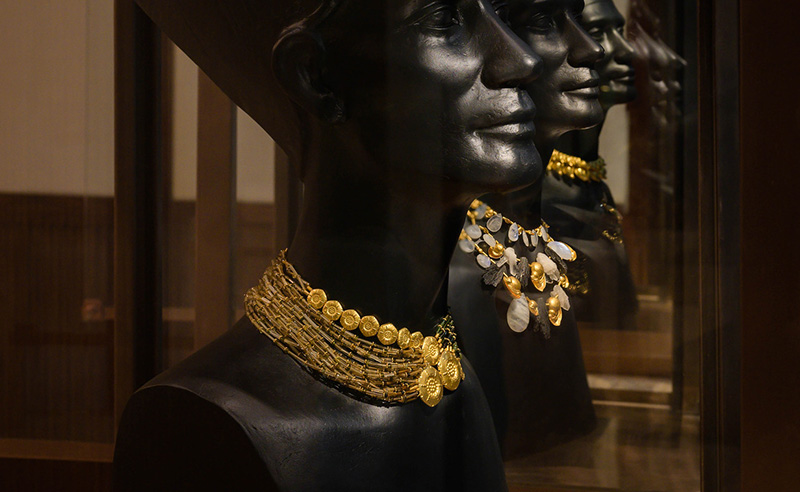 “All my life, my mission has been to show the world what Egypt is today - not only what it was 5,000 years ago,” Neamatalla says. “Egypt is the inspiration of the world.” In this sense, Nakhla’s presence at the museum feels like a natural extension of their brand. “Actually,” Neamatalla says with a smile, “we have a lot of people who enter who think it's a continuation of the museum.” In many ways, it is. The Grand Egyptian Museum - the largest in the world dedicated to a single civilisation - tells the story of Egypt’s past. The craftsmen, designers, and artists managing the shops within its walls tell the story of Egypt’s present.
When Nakhla first opened more than four decades ago, many Egyptian jewellers looked abroad for inspiration. “For people to be attracted to Egyptian work was unheard of. It was unbelievable how Egyptians looked down on Egypt. I’m not sure how we formed this opinion in our heads.”
Internationally, the fascination with ancient Egypt has ebbed and flowed over time - from Napoleon’s rediscovery of Egypt’s antiquities, to Howard Carter’s unveiling of Tutankhamun’s treasures, to today’s opening of the Grand Egyptian Museum. This enduring fascination can give the impression that Egypt’s design and craftsmanship are somehow frozen in time - something to be dusted off every few decades for the world to admire. What Nakhla demonstrates, however, is that it is not frozen at all. It is a living tradition, continuously evolving and expressing itself in the modern day. By adorning Nefertiti’s statue with Nakhla’s modern craft, the ancient and the contemporary meet as equals: bold, grand, and undeniably Egyptian.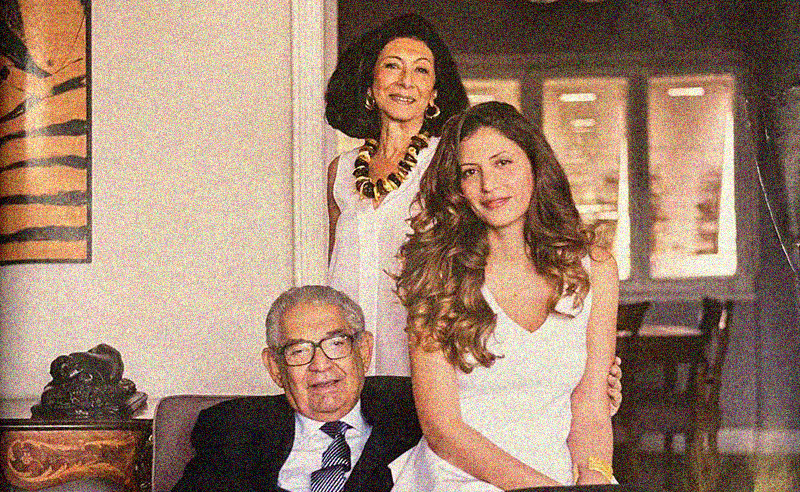 For Neamatalla, this belief in Egyptian craftsmanship and design is not abstract. It sits quite literally around her neck. She has worn the same necklace nearly every day of her life for the past thirty-eight years. It is beautiful and opulent: made up of blocks of amber, coral, wood, and Nakhla’s signature 21-karat gold. As the co-owner of Nakhla, alongside her husband, Ikram, one would think her own jewelry selection would be constantly rotating. But that is not how Neamatalla sees jewellery. “For me, jewellery is an ornament. All you need is a background for it”. While most people select their jewelry to match their mood or clothes, Neamatalla does the opposite. Everything she buys, everything she wears, has to match her necklace; her clothing and accessories orbit her necklace, as planets orbit the sun. “For me, otherwise, it’s an investment, one that will be put in a safe.” Jewellery is something that lives beside you, not something that waits silently for the right time.
“When you think about European jewellery, it’s a totally different approach to our part of the world,” she says. “My mother’s generation was completely Westernised, and I grew up in a house where nearly everything was European: English, French, Italian.” Her world widened for the first time when, as a teenager, she stepped foot in the house of her elderly neighbour, whose home was proudly decorated with Iranian cupboards, Turkish patterns, and Egyptian wooden decor. Neamatalla remembers how she instantly “fell in love with the house and its style, one that was totally different from the house where I grew up.”
In an age before the protection of antiquities, this neighbor, whom Neamatalla lovingly calls Tante Anna, would browse the old markets of Cairo for ancient treasures - pharaonic amulets, scarabs, coins - and delicately mount them within ornate silver frames. “This was on Wednesdays,” Neamatalla says. “On Thursday afternoons, the ladies of society would come and buy what we had displayed on her dining room table.” The dining table became a showroom; the gathering, an event.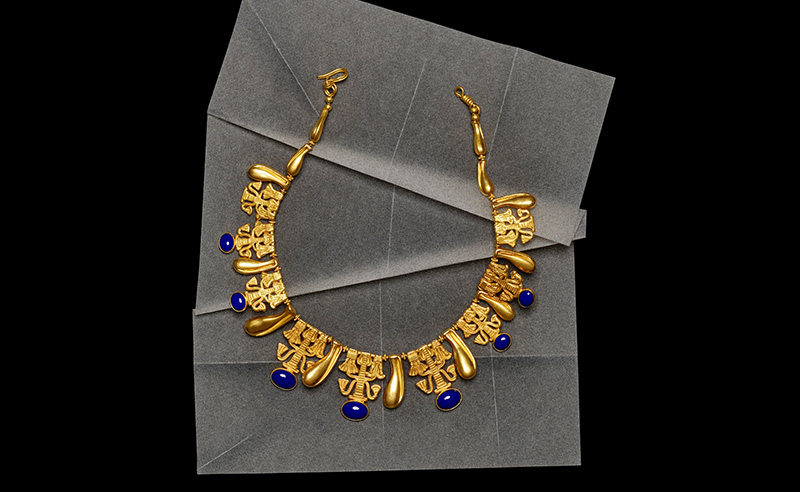 Ikram Nakhla, who later became her husband, was among those who attended these events. For the pair, this setting is what formed their understanding of jewellery: its foundations in Egypt’s ancient past, its ability to create gatherings of luxury and prestige, and its role as a living continuation of Egyptian culture rather than a relic of it.
While studying history at university, Neamatalla was struck by the relative absence of Egypt’s pharaonic past. “I always knew that there was something around Egypt, history, and art,” she remembers thinking. In later years, she would take classes whenever possible about Ancient Egypt, and broader Egyptian history. At this point, Ikram - now her husband and an engineer - was already dabbling in silver jewellery. “We didn’t have the money to work with gold,” she says, “But for me, the metal of Egypt is gold. Gold is the pharaonic metal. It's the nation's metal.”
When Neamatalla’s father-in-law asked if the couple would rather receive money for a business or for a flat, they said, “without hesitating, we want money for a business.” What started in the Nakhla family home was a modest but ambitious venture. Drawing on what they had seen at Tante Anna’s, they hosted gatherings where handmade jewellery was laid out for guests to discover.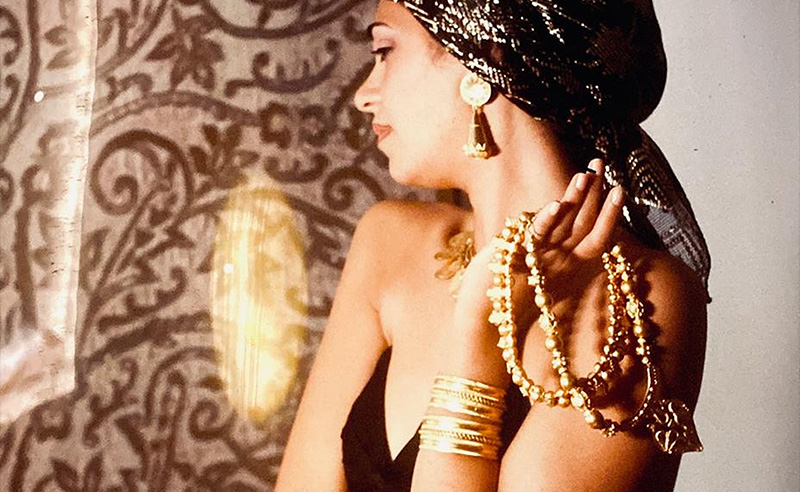 For several years, Nakhla grew quietly through these gatherings - until one woman helped to project Nakhla onto the international stage. Leia Marie Nadler, a close family friend of Neamatalla and the wife of former United Nations Secretary-General Boutros Boutros-Ghali, began wearing Nakhla’s designs at official functions. Through these networks of diplomacy and society, Nakhla quietly travelled across the Arab world, being admired by the wives and women of Middle Eastern political circles from Kuwait to Lebanon to Saudi Arabia.
“She was a superbly elegant woman,” Neamatalla says with fondness. As a diplomat’s wife, “she would take our pieces, and wear them officially as she rolled into embassies and parties.”
As interest in their designs grew, the couple decided it was time for a permanent space of their own. “I didn't even want it to be seen as a jewellery shop,” says Neamatalla, “for security reasons, and for another thing; discretion.” Neamatalla explains how her generation valued this sentiment: to be hidden and unseen. “Our shop was never, ever advertised; it was really only spread through word of mouth.”
One day in 1992, in what Neamatalla calls “a coup de chance,” Neamatalla was being interviewed by a journalist from the New York Times in Nakhla’s Giza shop. “Suddenly,” she laughs, “the road closed. Motorcycles drove past, and in came Mona Hrawi - the wife of the president of Lebanon.”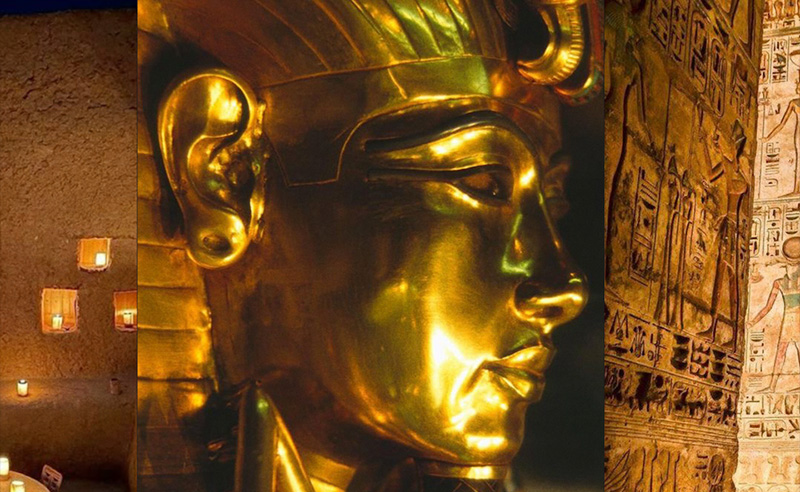 That article was then published and printed in Lonely Planet guides for Egypt in the following years, introducing Nakhla to the American market. Neamatalla giggles as she imagines the journalist’s bewilderment. From the outside, the shop was a mere thicket of plants; inside, a lone desk concealed drawers of jewellery hidden within. It must have seemed like an unlikely magnet for such high-profile customers.
Yet the quiet storefront concealed something far more deliberate: a vision for Egyptian jewellery that looked inward for inspiration. Nakhla’s jewellery draws upon the many civilisations that passed through Egypt - pharaonic patterns and stones, Greco-Roman art, and Islamic geometry. “Reviving these forms was in both mine and my husband’s DNA,” says Neamatalla. The pair noticed that, despite this wealth of inspiration, Egyptian jewellery had long fallen into two familiar patterns: “Making the cliché jewellery you see in markets - pyramids, a cartouche, or a small scarab - and copies of international brands”. She and her husband refused to follow that path. “Egypt taught the world the art of jewellery making,” she says. “For us to fall into copying others was unacceptable.”
In their designs, ancient civilisations are reborn into modern masterpieces. In a single necklace, one can glimpse layers of Egypt’s history etched into solid 21-karat gold: Old Kingdom motifs, Islamic geometry, Bedouin movement, even subtle European influences.
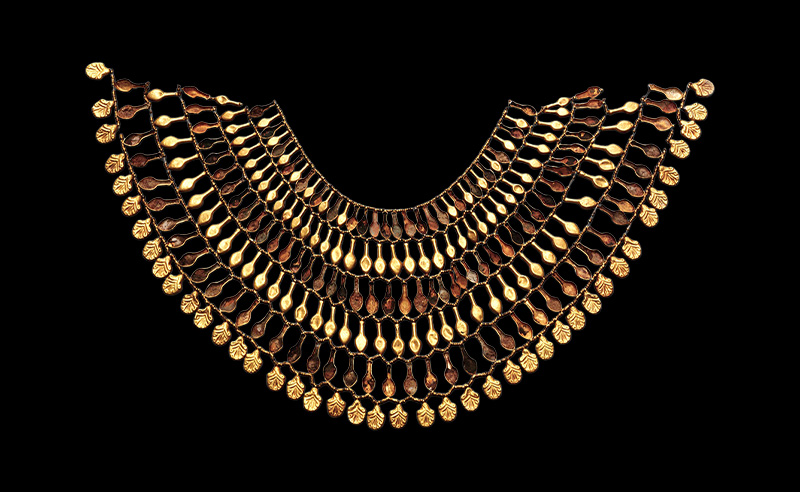
For Neamatalla, the secret behind this timelessness lies not only in design, but in the way the jewellery is crafted. “When you look at pieces of jewellery the pharaohs made, there are some that are just as modern and just as wearable as they are today.” Walking through the museum proves her point: ancient necklaces and bracelets on display appear surprisingly contemporary.
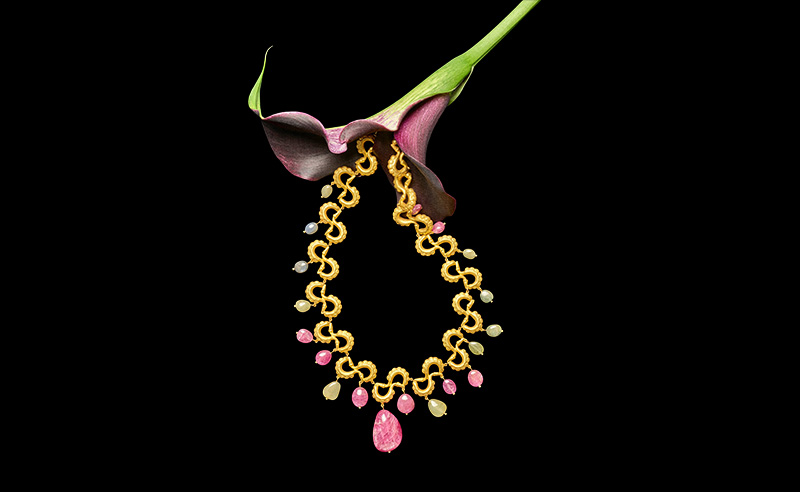 In fact, displayed in a room of ancient jewellery a few steps away from the Nakhla store, I saw a beautiful golden ring on a peculiar swivel hinge. Several days later, I saw a similar mechanism posted on Nakhla’s Instagram page. When I asked Neamatalla about her inspiration for this, she explained how much work had gone into recreating it.She told me how when she first approached her craftsman to inquire about replicating the ancient ring’s design, he simply said he could not. Half-joking, half serious, the craftsman replied: “The man who made this ring dedicated his whole life to this ring and nothing else. He designed it, made it - and then he died.” It was the life’s work of a single artisan, a piece of devotion forged thousands of years ago. Nakhla serves to revive this almost obsessive commitment to craftsmanship today, honouring the traditions and mechanisms of past artisans with their own.
Like pharaonic jewellery, no two Nakhla pieces are identical; each bears the subtle marks of the hand that shaped it. This key component of Nakhla - one that is branded in the precious stones and delicate handiwork - is what sets Egyptian craft above all else, says Neamatalla. “Other countries have better machines,” she admits, “but we have the real talent in the handcrafted, the handmade.”
This is what Nakhla is now showing the world through its new shop: what Egypt achieved thousands of years ago, and what it continues to achieve today. When Neamatalla was first approached about opening in the museum, she laughed. “I’m 73. You must be joking. I am not opening a shop anywhere!” Instead, she passed the decision to her children, Mounir and Malak - “the future of Nakhla,” as she calls them.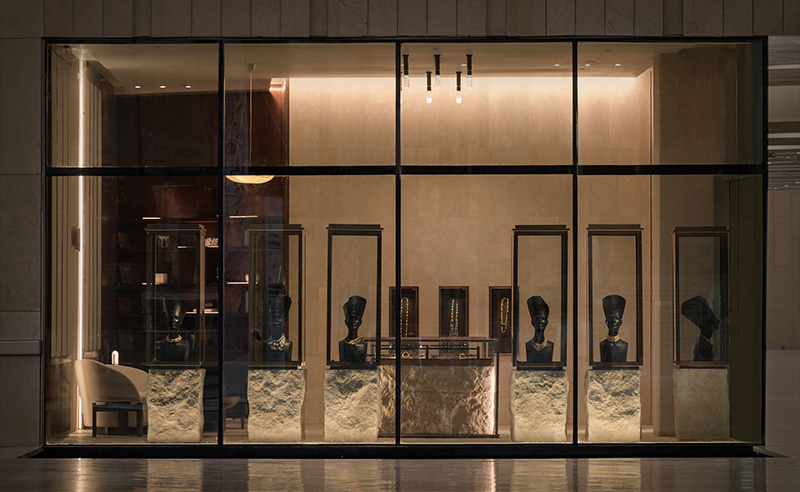 Together with Yasmina Makram and Ingy Magar, they designed the store with the same philosophy that has guided their parents’ brand for decades. Perched upon rugged stone blocks is where the jewellery is displayed, encased beneath glass not unlike the 5,000-year-old jewellery on show in the museum’s galleries.
Neamatalla especially loves the idea that it is Nefertiti who models her work in the store. “She’s really the perfect neck for our necklaces,” she says. The details of the shop work to show the world what Nakhla is. Unlike the discreet Giza store, the museum boutique is what Neamatalla calls “an opening to the world.” Visitors from Indonesia, Russia, China, and beyond are now encountering Nakhla for the very first time.
“I am happy that they can see our work,” she says. “Egypt cannot live on its past glory alone. People have to see what we do today, not only the glory of the pharaohs.”
When I ask about her current priorities, Neamatalla smiles with relief. Her daughter, Malak,has taken over the role of jewellery design. “Today,” she laughs, “my role is the awful critic.” In this way, Nakhla is not only an heirloom of Egypt - passed down over centuries, across kingdoms, millenia, craftsmen - it is the heirloom of a family.
 Neamatalla may be stepping back from Nakhla - leaving it in the hands of her children - but she is far from finished. As she and her husband gradually pass the family business onto the next generation, they are spending more time in Siwa, dedicating themselves to development projects that aim to turn the talents of local artisans and craftsmen into sustainable livelihoods. Through her initiative, ‘UDJAT Siwa Creations’, Neamatalla works closely with women in Siwa to preserve traditional artistic practices while creating new economic opportunities.
As our conversation wound down, I saw Neamatalla reach instinctively for the necklace she has worn for nearly four decades; an extension of herself. This necklace is, in many ways, the philosophy of her life's work made visible - handmade, enduring, rooted in the past yet worn proudly in the present. Across the atrium from Nakhla, ancient treasures displayed behind glass are admired as artifacts of a finished story.
Nakhla continues that story. Inside their store, the glass opens; and you can try on history for yourself.
- Previous Article Monochrome Monday: The Star White Edition
- Next Article SELECTS: Model Romy Nassar Styles Her Maximalist Vintage Collection