Amina Khalil’s Fawazir Collection Flirts With the Televised Fantasy
Drawing on the televised fantasy of 'Fawazir', Amina Khalil’s FW25 collection reflects on performance, memory, and the tension between wearability and artifice.
For decades, 'Fawazir' shaped how Egyptians experienced Ramadan nights: families would gather after iftar, waiting for riddles, music, and extravaganza. The show was aired at the same hour each night and truly anchored the evening. Each episode felt like a mini world reset where sets changed, characters shifted, music swelled and deswelled. The attires, in particular, were play, drama, humor, and wonder. For many, this was an early brush with the avant-garde, shaping how Egyptians understand dressing up, excess, and performance.-65f7a050-a5cf-4362-8af5-71f84617b605.jpg) Amina Khalil remembers this all too well. “I grew up watching 'Fawazir,'” she tells SceneStyled. “It allowed me to dream and to enter another world. I was fascinated by the costumes and how much what they were wearing added to the story.”
Amina Khalil remembers this all too well. “I grew up watching 'Fawazir,'” she tells SceneStyled. “It allowed me to dream and to enter another world. I was fascinated by the costumes and how much what they were wearing added to the story.”
Long before Amina K. existed as a brand, 'Fawazir' informed how Khalil understood dress, performance, and public fantasy. “That was my first real awareness of clothes as something expressive,” she says. “It was my first introduction to fashion.”
Years later, that memory became the foundation of Fawazir, Amina K.’s FW25 collection. With it, Khalil does not recreate television costumes or archive silhouettes but rather focuses on the feeling, the pleasure of an act and the idea of stepping into another version of yourself, even momentarily.
“'Fawazir' showed a different side of Egyptian show business,” she says. “Not glamorous exactly, but celebratory. There was glitz, but it was about show.”
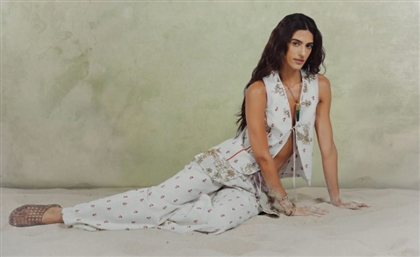
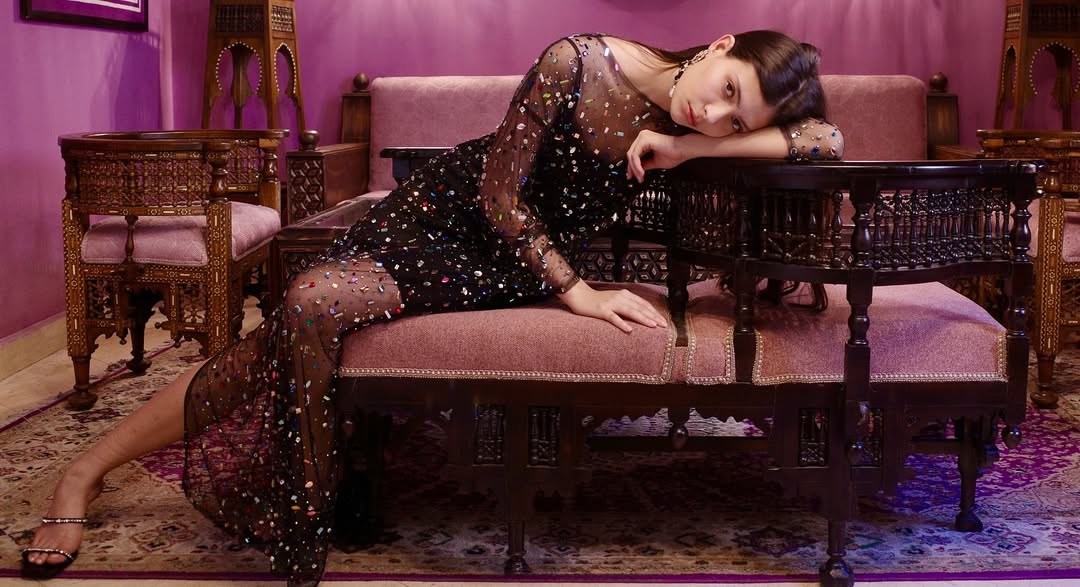
The Fawazir collection does not chase extravaganza for its own sake, it is all about works through contrast. The collection is built on classic forms that include tailored suits, skirts, shirts, cropped jackets and kaftans, all with shifting surfaces.-403f334b-2b2e-4efe-bd00-3a80c84eb66f.jpg) At Fawazir, a loud patchwork textile appears across several silhouettes: quilted jackets and kaftans are cut with volume but held in check through careful tailoring, allowing embroidered surfaces, metallic threads, and dense beadwork to carry the visual weight. Sparkly blazers are softened by sheer bomboni tops; chiffon Arabian shirts are layered under structured bustiers, creating a push and pull between transparency and armor. Nothing too ornamental for the sake of it. Each material flirts with excess, then reins itself in.
At Fawazir, a loud patchwork textile appears across several silhouettes: quilted jackets and kaftans are cut with volume but held in check through careful tailoring, allowing embroidered surfaces, metallic threads, and dense beadwork to carry the visual weight. Sparkly blazers are softened by sheer bomboni tops; chiffon Arabian shirts are layered under structured bustiers, creating a push and pull between transparency and armor. Nothing too ornamental for the sake of it. Each material flirts with excess, then reins itself in.
“Fawazir is a big theme, and everyone has their own connection to it,” Khalil explains to SceneStyled. She was careful not to overwhelm the wearer. “We did not want people to feel like they were wearing a costume, it needed to feel approachable.”
That convention also shapes the woman Khalil designs for. “She wants to stand out,” she says. “Glitzy, but playful. Elegant and a bit bold.” The image remains open. “Women have different sides, you might be simple during the day, but there is always a night where you want to step up.”
That thinking shows in the collection’s range. “I do not believe in fillers,” Khalil says. “Every piece needs a reason to exist.” She asks herself direct questions while designing: what does this add, why does it belong here and would someone reach for it more than once.-bc2c578b-fdb2-4980-b7ea-74a30a4e28cc.jpg) Amina K., since its founding in 2009 in Cairo, has believed in limited quantities. Many pieces rely on hand embroidery and beading with fabric access often setting the limit. “We do not buy thousands of meters,” Khalil says. “And when something sells out, that is it.”
Amina K., since its founding in 2009 in Cairo, has believed in limited quantities. Many pieces rely on hand embroidery and beading with fabric access often setting the limit. “We do not buy thousands of meters,” Khalil says. “And when something sells out, that is it.”
This approach places the brand firmly within slow fashion with a process that simply follows reality where handwork takes time and raw materials are not endless. “People who buy into the brand appreciate that,” she says. “They know these are not mass-made garments.”
The workshop is central to that process. “I give guidelines,” she explains. “Colours, beads, threads, style.” After that, women work with her experiment. “They bring their own way of embroidering or beading, and I curate it.”
In slow fashion, sameness is not the goal because the practice values context over repetition. The point is not to produce identical copies that flood the market, but to allow variation and lived texture to show through the garment. “Not everything is exactly the same, and I like that,” she says. To Amina, quality remains non-negotiable, but variation signals life. “They are part of the creation.”
Some garments require years of development. The Nogoom Bustier, new to the brand, demanded repeated testing with structure, comfort, adjustability, and fit across bodies all mattered. “It was not a one-season piece,” Khalil says. “We worked on it for years.”
The Bomboni pieces were challenging when it came to finding silhouettes that felt easy to the wearer but still carried shine. Additional handwork was layered onto existing fabric to reach the right balance. “Every piece took time,” she says. “Even the white shirt.”
The collection’s visual language extends beyond the garments to the props. The shoot took place in Old Cairo, inside a location layered with history, texture, and color. “It would have looked staged in a studio,” Khalil says. “At Le Riad De Charme, every room had a different energy.”
“Sherihan used to take us on different journeys,” she says. “The sets would change, the costumes would change and everything shifted depending on the story.”-093adbdd-ef4d-4229-ae69-7e2c3f6298b0.jpg) Releasing Fawazir came with hesitation. “I was worried,” Khalil admits. “I did not know how people would take it.”
Releasing Fawazir came with hesitation. “I was worried,” Khalil admits. “I did not know how people would take it.”
“Egyptians are joyful by nature,” she says. “We love gatherings. We love being entertained.” Revisiting 'Fawazir' reopened a shared memory and introduced that history to younger buyers who may not have lived it directly.
At 40, Khalil really grew up alongside her brand. “My wellbeing matters,” she says. “The energy of the brand matters.” Challenges have shifted over time where early years were about learning, mistakes, and building structure. Today, competition is sharper, raw materials are shared and inspiration circulates fast. “You have to stay aware of your point of view."
- Previous Article Egypt's Nuniz & Rebel Cairo Collaborate on Celestial Leather Bag
- Next Article MAILLIW Defends the Grandma Floral’s Right to Misbehave