Q&A: Designer Zeighn Talks Identity, Vogue & 'The Palestinian Wedding
"Mama, Baba look, Vogue!" — SceneStyled caught up with fashion designer Zeighn Abu Al-Teen to discuss the making of her thesis look ‘The Palestinian Wedding' and using fashion to platform the cause.
Originally published on March 15th, 2026.
Zeighn Abu Al-Teen is a Palestinian mixed media artist and fashion designer based between Amman and New York City. It has been over a year since she graduated from the Parsons School of Design in 2024 with a thesis collection that made it to Vogue Runway. She did not expect her interpretation of ‘The Palestinian Wedding’ to be one of the projects featured in the Vogue lineup from Parsons’ Grad Runway—especially in the midst of the Gaza genocide, a time when open expression of Palestinian identity on American college campuses was often dangerous.
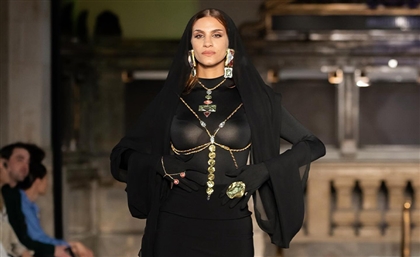
SceneStyled spoke with Abu Al-Teen about creating the ‘Palestinian Wedding’, a story that strays from the traditional attire - an ode to wearable history, indisputable existence, and the multifacetedness of what it means to be Palestinian - written in Swarovski jewels.
What does it mean to you to be Palestinian?
I am from Tulkarem, from a village called Irtah. My grandparents are Palestinian refugees who moved to Jordan - and my father was raised in the diaspora. My mom was born and raised in Quds, originally from Khalil. My parents married in Jordan, which is where I was born.
 That’s what it means to be Palestinian: we don’t all end up in the same place. We don’t all have the same experiences with Palestine. We don’t all share the same struggles, and we don’t all share the same joys.
Speaking to other Palestinians and telling them my experiences as somebody who grew up in Jordan, then went to college in the West, and what I went through in both places - it looks very different from my friends who were Palestinian-American and raised there, or my friends who were raised on Palestinian land and then eventually moved elsewhere.
The only time I was able to visit Palestinian land, was actually when I got naturalized as an American, very recently. Growing up, I carried a Palestinian ID that restricted me to the West Bank, and it was difficult to go in and out. Eventually, the only way that made sense was to go in as an American, which is ironic. I was able to visit my mom’s family and see where she grew up and enter her home. I also got to visit my great-grandfather’s home in Tulkarem. There was an entire village of us, of my entire family, that I would have never learned about, if I wasn’t able to go to Palestine.
How did fashion become the space for you to tell Palestinian stories?
As any other artist, I am exploring myself and my identity, and I am first and foremost a Palestinian. It became this journey of learning about myself and my family’s history - learning more about what it means to be a Palestinian - and realizing that we are not one size fits all.
Every one of us has a unique story, and through my art-making practice, I realized we don’t talk about it enough. We don’t talk about how our very individual circumstances as Palestinians create an extension of the story of what it means to be a Palestinian. That’s when my practice became very community-driven. Without having these multiple voices in every piece and project, I’m not accomplishing what I want to accomplish as a Palestinian artist.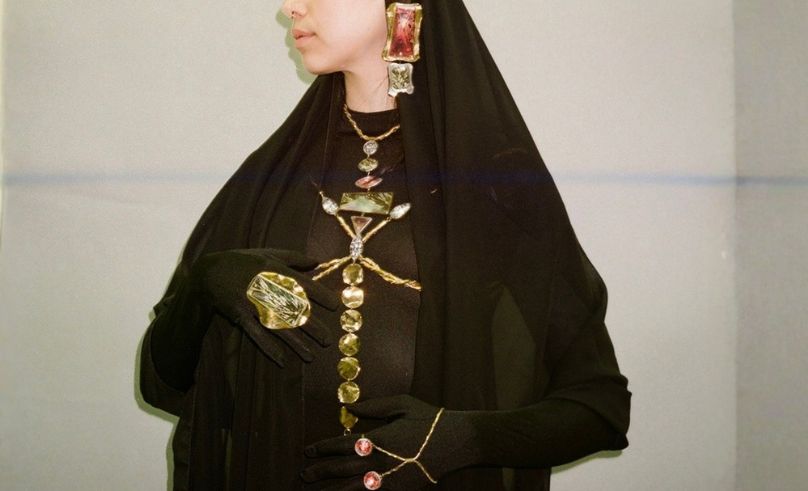 It is clear that your identity is front and center in ‘The Palestinian Wedding’. Can you walk me through your creative process?
The Palestinian Wedding started in June 2023. It felt like the perfect conclusion to my college degree. In my final semesters, my overarching theme was: how much we love, and how much we live. That was concluded through a poem called “Love, Palestinian Style” (حب على الطريقة الفلسطينية), by Palestinian poet (Abd al-Latif) Aql. The overarching theme of the poem is that through everything, with the push from the land, we are pulled toward it. With destruction comes growth. The duality that exists with being Palestinian, where regardless, we are still so eager to love and so eager to live.
I began my research by looking at 18th-century Palestinian jewelry. I contacted a few collectors and saw the pieces firsthand, looking at amulets in our jewelry and the way we tell our stories through body adornment. Historically, you could read a woman’s story through what she wore - through her jewellery and her garments.
It was the idea of borrowing that from our culture: the ability to storytell through body adornment, to tell how much we love and live.
I am researching flora, fauna, the land, silhouettes - how the land translated into wearable garments. I am speaking to my grandparents, listening to their stories, looking at my stories, looking at the world around me.
And then came the genocide.
How did your work change when the genocide started?
I came into art to use it as a platform to speak on Palestine. But when the moment came, it felt really scary - not because I was afraid to speak, but because it felt like I was living my grandparents’ story. It’s not that it ever stopped, but it felt very much like all the stories we heard from the Nakba and the Naksa. You always hope that Palestine gets the platform and the recognition it deserves. You think that’s all it takes for the world to understand that we are here and this is happening. And for the first time ever, I saw Palestine everywhere. At the time, I was in the U.S., so to see it in that magnitude - on the streets, on the news, on people’s tongues - and yet there was no action.
That’s where the fear came in.
The problem is not a lack of awareness. It’s a way bigger issue. Palestinian blood is cheap to the rest of the world. People are not as empathetic as you think they are. Yet here we are - and we still love and we still live. The concept of ‘The Palestinian Wedding’ did not change. It felt ten times more relevant.
I realized: this has nothing to do with the West. This is about us. I will do it for me, for my ancestors, for us, for the story.
As silly as it sounds to make jewelry pieces in the midst of a genocide, you go ahead and do it. To exist in these spaces is integral. Art is history. Media is history. I want the world to know that we still love and live, no matter what.
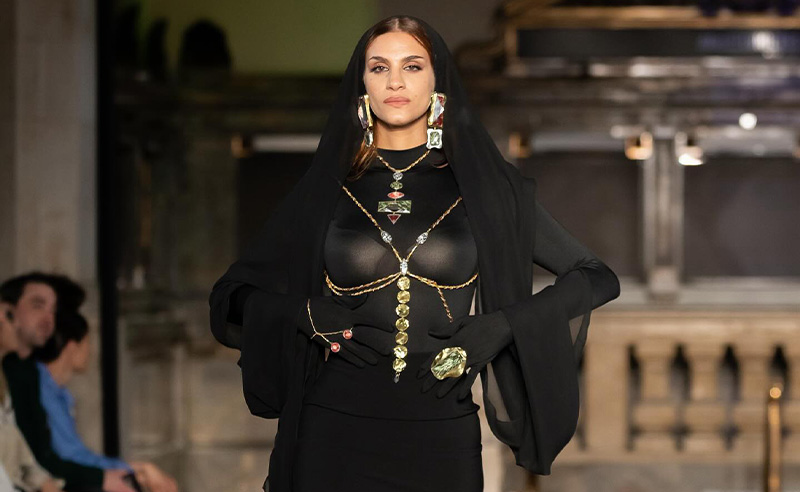
That’s how the Palestinian wedding concluded. I was surprised by the press it received, given the moment we were in. I didn’t do it for the press. I did it for healing—for me and for those around me. To remind ourselves of who we are despite what the world inflicts on us.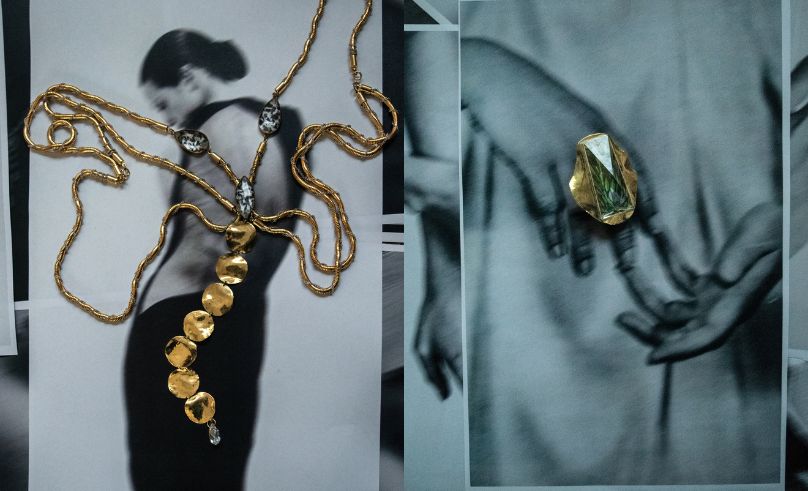 When I saw the photos, it didn’t look like traditional Palestinian wedding attire. Tell me about the details of the look.
Yes. Most of what was translated from the research were the amuletic references in the jewelry. Palestinian jewelry is functional. If a woman wanted a child, she would wear a certain piece. If a family wanted to become richer, she would wear another. These pieces come together to tell a narrative and perform a function.
Everything was intentional. Most amulets appear in odd numbers - symbols of good luck. You see that in the number of amulets and in the engravings. A big part of Palestinian jewellery was that certain pieces would open up and store paper or other elements, so the jewellery also functioned as storage. These ideas translated aesthetically into the collection.
Many of my pieces are also in odd numbers, as an ode to that. All of my pieces were signed by me, inspired by the fifteen most famous silversmiths in Palestine, who signed their pieces. They were all men, though the people telling stories through body adornment were women. So it became a subtle shift in the narrative: rooted in tradition, but with a clearer layer of authorship.
The idea of “encompassing” was very intriguing. Women historically carried parts of their culture within their jewellery - literally stored in compartments. I wanted to encompass elements of the land I am constantly far away from. What I landed on was creating prints of the flora and fauna of Palestine - there’s a sumac print, a dove print, and an olive print - then encompassing them within metal and glass. The crystals and collection was sponsored by Swarovski.
So this idea of encompassing became the idea of protecting the land behind glass, and simultaneously carrying it with you the same way Palestinian women carried parts of their narrative with them. That’s where all the color comes in: the layered prints held within these enclosures.-b544fce9-ef17-4cb8-b80a-ffa7bfc668dc.jpg) The attire is inspired by general silhouettes of Palestinian women -the thobes and headdresses. The focus was on the jewelry. When we think of traditional Palestinian wear, we think first of the embroidered thobe, which is stunning. But I realized there are more chapters to this story - the jewelry. That’s why the silhouette is fairly simple, with the emphasis leading the eye straight to the pieces.
The attire is inspired by general silhouettes of Palestinian women -the thobes and headdresses. The focus was on the jewelry. When we think of traditional Palestinian wear, we think first of the embroidered thobe, which is stunning. But I realized there are more chapters to this story - the jewelry. That’s why the silhouette is fairly simple, with the emphasis leading the eye straight to the pieces.
Did you know you would be featured in Vogue?
We knew Vogue was there to take images. We did not know whether we would make the cut.
Backstage, the model, my friend and I were ignored by the behind-the-scenes photographer - she did not want to photograph three Palestinian women in kufiyyehs. We thought there was no way we were going to make it into the final Vogue lineup.
But we did. I thought it just slipped in - the photo wasn’t labeled and there wasn’t an artist statement. So what really surprised me was the press and the interest that came afterward. Despite there being no accompanying explanation for the runway photo, they sought more. Then interviews started rolling in: “Where did this come from? Tell us more, tell us your story.”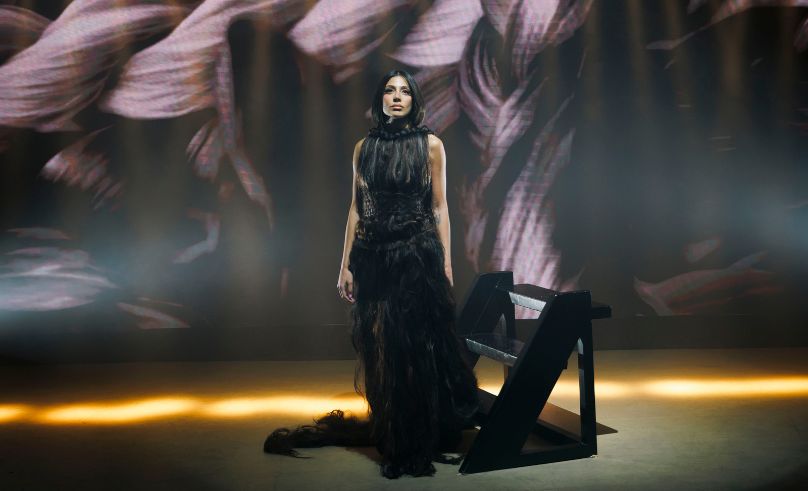 That momentum, still to this day, has not stopped - and it’s been more than a year since the runway.
We love, and we live, and everybody wants to know about it. That was the goal. It’s not about telling the West who we are or that we deserve to live. It’s not about convincing anyone that we are Indigenous to this land. We know that. What matters is that we continue to practice what it means to be us. In conclusion of everything I’ve done: to be us is to be souls that are so loving.
- Previous Article Monochrome Monday: Cloud Pink
- Next Article Qatar Label Wadha Weaves Islamic Art Into Luxury Fashion