Dina Kamal Designs Jewellery for the Architecture of the Body
Kamal’s pieces don’t sit on the body so much as adjust its posture, redistribute its weight, and somehow make the wearer newly aware of their own form in space.


Dina Kamal is obsessed with construction pits. She stops to look into them each time she passes one in a studied inspection, tracing the raw earth and the layered lines of excavation. "Construction pits and manholes have always fascinated me," she tells SceneStyled. "Mainly in the way that they help us relate to our sense of space; layers, grids, changing scales. These things allow us to see ourselves beyond the typical context of being and establish new grounds of construction."
This intentional idle musing is, in fact, precisely how Dina Kamal designs jewellery. The Lebanese architect-turned-jeweller founded DINAKAMAL DK01 in Beirut in 2010 and has since been steadily establishing herself as one of the most architecturally informed practices in contemporary jewellery design, sold at Dover Street Market locations in London, New York, Los Angeles, and Singapore, and worn by people who consider a ring beyond a bauble and somehow a statement of world-view. She crafts her pieces using 18k gold, often featuring diamonds, and always in her signature beige gold - 18k without copper, "truest white gold as there can be."
The shift from architecture to jewellery is what most people first question, and Kamal uses any but the term transition to describe it. "For me, it’s an extension, a detail."
 The first piece she made, the Flat Plate Pinky Ring, came out of an architectural research project, a study of identity and context that led her to the historical significance of the signet ring. Kamal became absorbed by the story of a single object that had functioned, across thousands of years and dozens of cultures, as proof of belonging, instrument of authority, and mark of protection, all compressed into the circumference of a little finger. Her response was to take that object and strip it of everything except its presence with no wax seal, no family crest, no inherited meaning. Only form, proportion, gold, and whatever weight the wearer brings to it themselves. It has been her signature ever since, and it contains, in miniature, the logic of everything that followed within her practice.
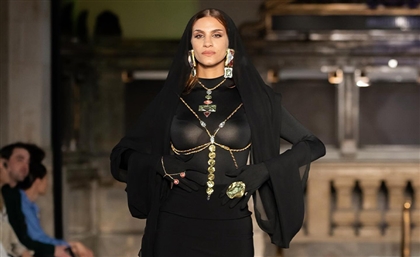
"In our design process, we always consider context, proportion, material and structure, and the balance required for the creation of opposites," she explains. "We create bold and discreet objects, sensual and structured ones, masculine and feminine." It is this juxtaposition of the monumental and the everyday, of the structural and the sensitive, that gives Kamal's creations a unique quality among fine jewellery designers. Other designers can begin with the gemstones and move out; Kamal begins with the body and works from within.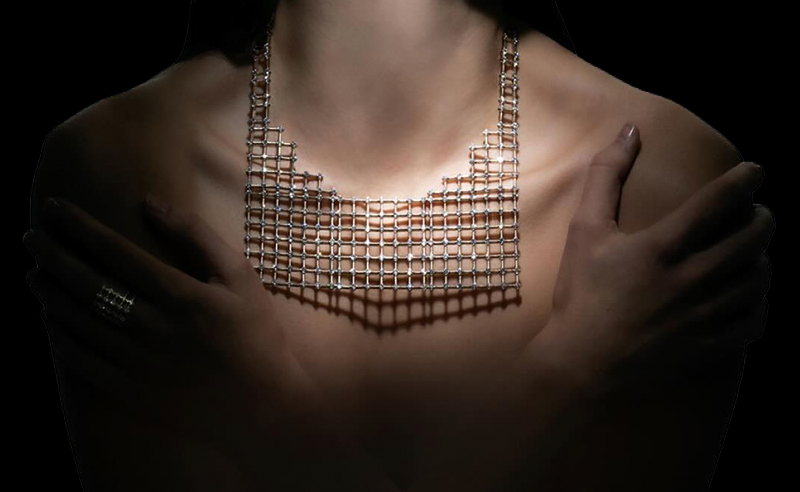 This brings us to the Square Web Necklace, which she describes straightforwardly as a breastplate. Breastplates were the most intimate armour that warriors wore, custom-made to cover their bodies and designed both to absorb shock and facilitate movement. "Inspired by the structure of mesh armour and chainmail, the Square Web Necklace brings a modern idea of breastplates to life through gold and diamonds," she says. "With references to romantic concepts such as the 'knight in shining armour,' the piece is a modern breastplate to showcase strength and empower the wearer."
The idea of jewellery as precious armour is present throughout Kamal's work. "I see jewellery as something that can help change the way you feel, change the way you present yourself to the world." Kamal doesn't just seek to adorn her wearers; she almost casts a protective spell around them. For example, The Tube Torc, inspired by the neck rings used by ancient warriors to denote status, aims at something very particular in its wearers; drawing attention to their form, to their posture. It reaches back in time.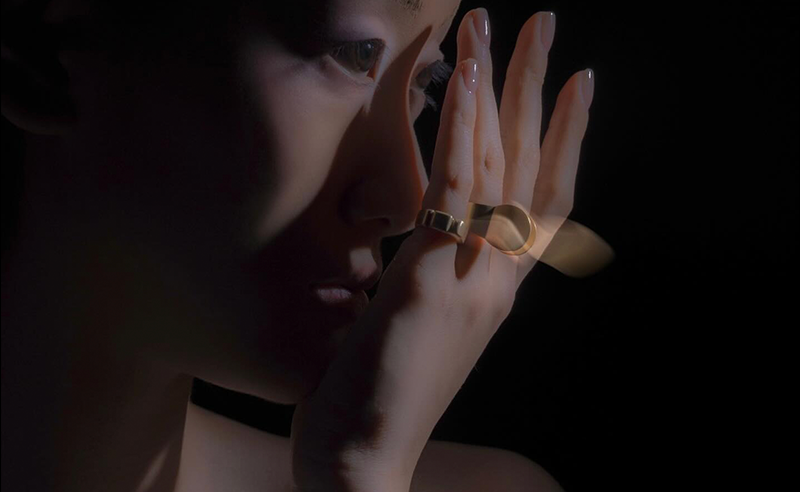 Each of Kamal's pieces begins with an object of fascination, a concept, a story sometimes from nature and history, mythology, or even something as prosaic as the Michelin Man. "When choosing to get fascinated by anything, a new set of ideas and forms emerges," she says. Fascination leads to research, which leads to intentionality - what a piece will feel like. Then comes the design process, where she applies her architecture skills to the materials of goldsmithing. "In my opinion, all those technical limitations in design serve as a driving force," she observes, "As an architect, you not only have to think of the beauty of a piece and how it will look in the environment around it, but also of all the technical aspects of its creation," Kamal continues.
That way of thinking never leaves the body. Kamal’s pieces don’t sit on it so much as adjust its posture, redistribute its weight, and somehow make the wearer newly aware of their own form in space.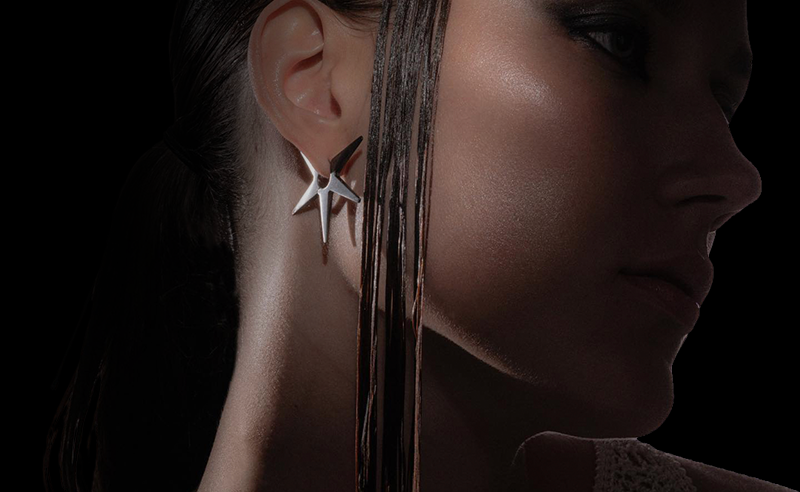
- Previous Article Monochrome Monday: The Lady in Red Edition
- Next Article How One Tumblr Kid Turned Obsession Into Dubai-Based H5 Lab